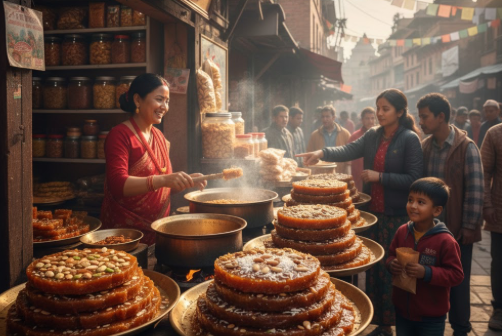
In the shadow of the world’s tallest peaks, food has always been about more than just taste—it has been about energy, preservation, and celebration. While the global culinary map is often dominated by French pastries or Italian gelatos, Nepal hides a “sugar secret” that is centuries old.
The story of Nepali sweets is a story of a civilization that learned to condense the richness of the mountains into bite-sized treasures. From the high-energy treats of the Silk Road traders to the sacred dumplings of the Newar harvest, let’s explore the deep-rooted origins of Nepal’s most iconic desserts.
1. The Alchemical Art of Khuwa and Chaku
At the base of almost every traditional Nepali sweet lie two primary elements: Khuwa (concentrated milk solids) and Chaku (caramelized molasses).
- Khuwa: The White Gold: Historically, Nepal’s lush mid-hills were home to a thriving dairy culture. Before refrigeration, farmers needed a way to save excess milk. By simmering it for hours in heavy iron pots, they created Khuwa—a dense, protein-packed base that could last far longer than liquid milk. This became the DNA of sweets like Peda, Barfi, and Gudpak.
- Chaku: The Winter Fuel: While India became famous for its refined sugar, Nepal perfected the art of Chaku. Made by boiling sugarcane juice until it turns into a dark, viscous taffy, Chaku is more than a sweetener; it’s a thermal food. During the freezing Himalayan winters, a piece of Chaku provides instant heat and energy.
2. Yomari: The Teardrop of the Harvest
Perhaps no sweet is as architecturally distinct as the Yomari. This steamed rice-flour dumpling, shaped like a fish or a pointed fig, is the crown jewel of the Newar community.
- The Legend of Panauti: Folklore tells of a couple in Panauti who first experimented with rice flour and Chaku. They offered their creation to a passerby who turned out to be Kubera, the God of Wealth. Blessed by his satisfaction, the couple prospered, and the tradition of making Yomari during the full moon of December (Yomari Punhi) was born.
- Symbolism in Every Bite: The pointed ends of a Yomari are said to represent the north and south poles of the earth, or the male and female energies. Even the act of eating it is ritualistic—one bite into the soft rice casing releases a molten river of warm Chaku and sesame seeds, a perfect antidote to the December chill.
3. Juju Dhau: Why the “King” Lives in Bhaktapur
Legend has it that during the Malla era, a king organized a yogurt-making competition between the three kingdoms of the Kathmandu Valley. The artisans of Bhaktapur won, and their creation was bestowed with the title Juju Dhau—literally “The King of Yogurt.”
- The Science of Clay: Juju Dhau is made exclusively with buffalo milk, which is richer and creamier than cow’s milk. It is set in unglazed clay pots (Kataura). The porous clay acts as a natural filter, absorbing excess moisture and leaving behind a yogurt so thick and velvety it feels like a soft cheese.
- A Sacred Blessing: In Nepali culture, yogurt symbolizes purity. No student leaves for an exam, and no traveler begins a journey without a “tika” of yogurt on their forehead.
4. Lakhamari: The Sweet Shield of Marriage
If you attend a Newari wedding, you will see massive, intricately patterned rings of Lakhamari. These are not just cookies; they are a public declaration of a union.
- Durability as a Metaphor: Made from rice flour, black lentil flour, and sugar, Lakhamari is deep-fried to a hard, crunchy texture. Its ability to stay fresh for weeks without preservatives made it the perfect gift to be sent between families during long wedding negotiations. It symbolizes a bond that is strong, sweet, and enduring.
5. The Modern Renaissance: From Asan to the World
Today, the Nepali sweet market is undergoing a fascinating shift. Brands are now packaging Pustakari and Gudpak in sleek, export-quality boxes, finding fans in London, New York, and Sydney.
What was once a local survival food is now a high-end gourmet souvenir. This resurgence isn’t just about business; it’s about reclaiming a cultural identity that was almost overshadowed by Western fast food.